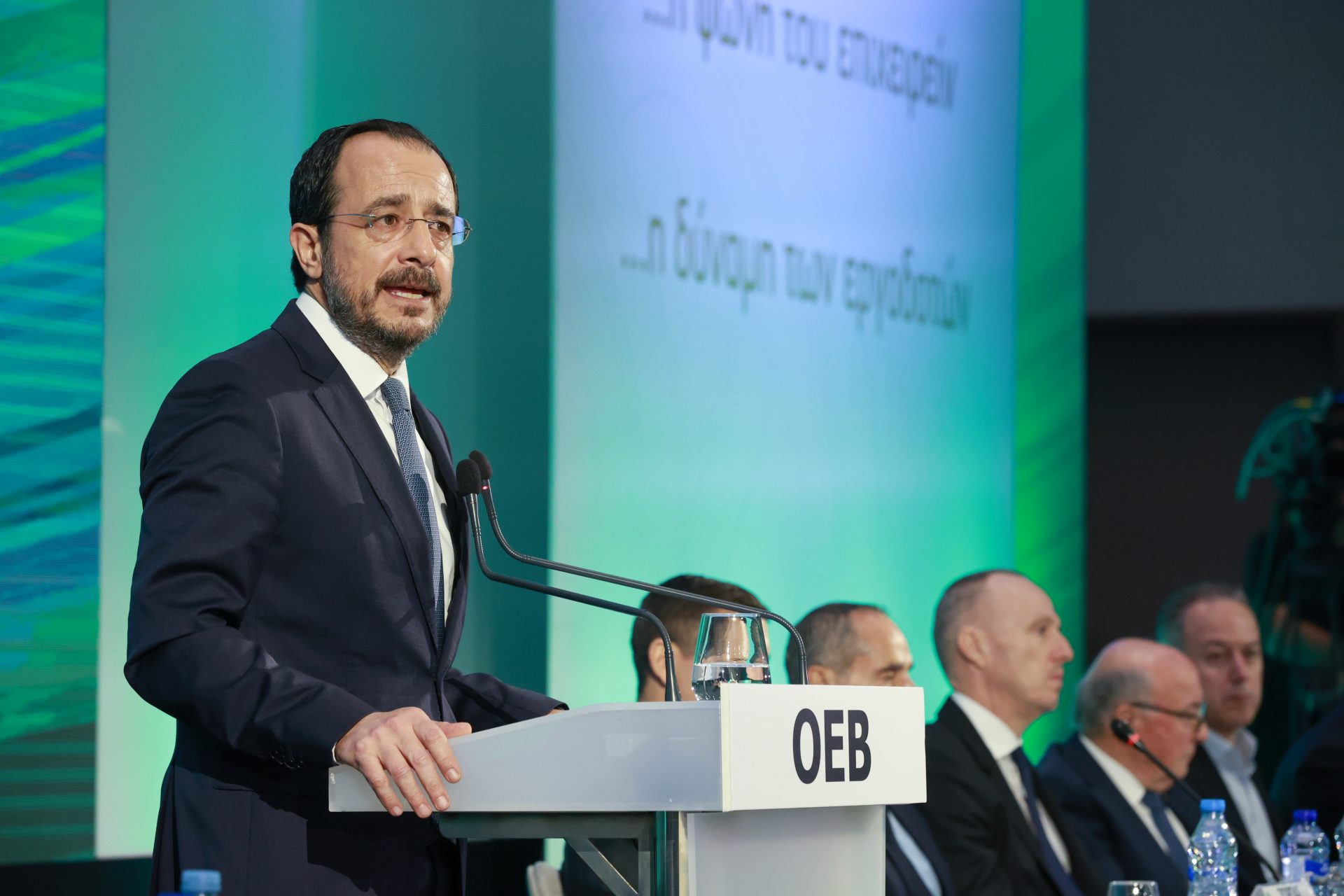
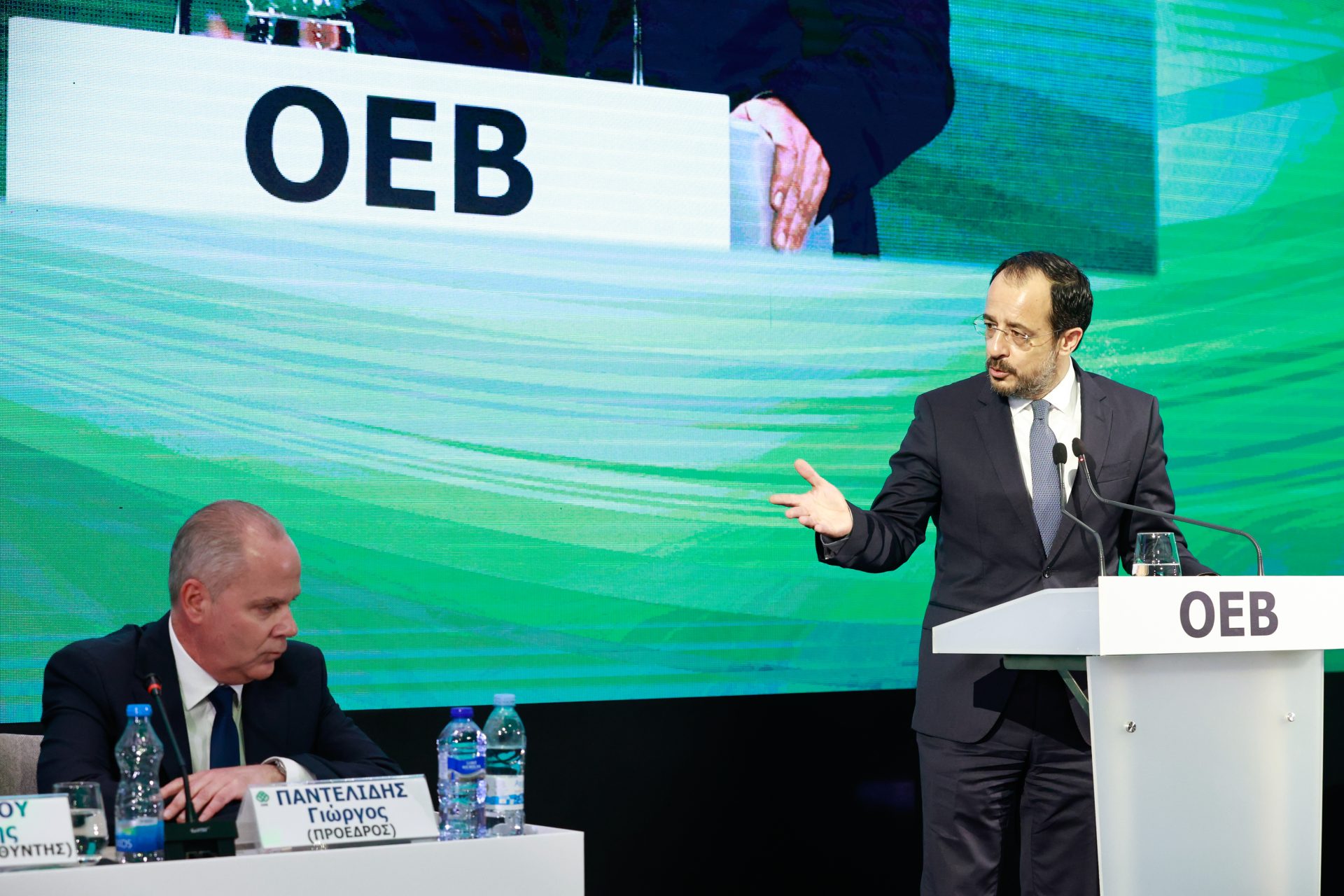
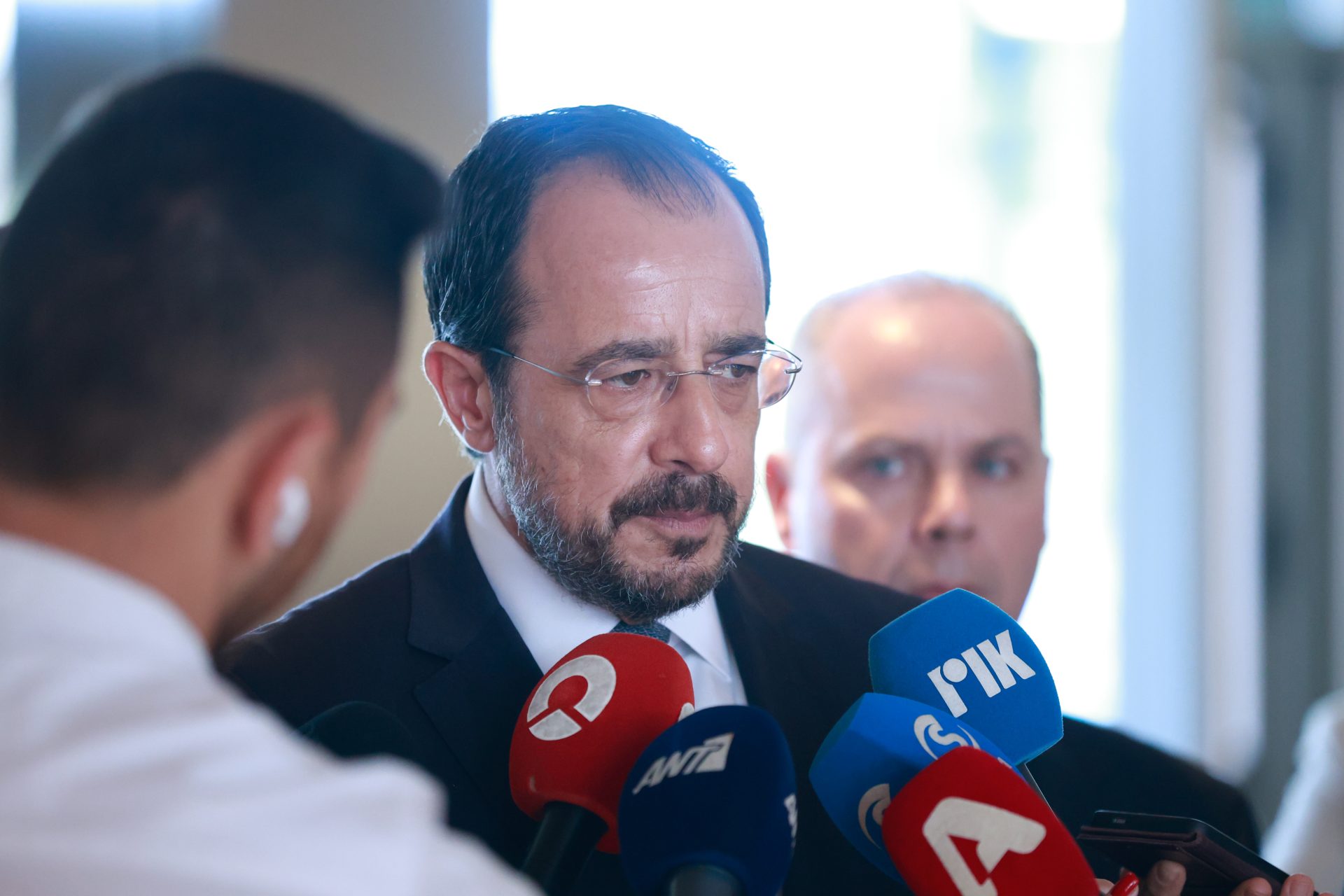
Speech by the President of the Hellenic Republic, Mr. Nikos Christodoulides, at the Annual General Meeting of the Employers and Industrialists Federation
It is with great pleasure that I participate again this year with several members of the Council of Ministers in the annual General Assembly of the Federation of Employers and Industrialists (OEB). Allow me to begin by expressing my warm thanks to the Leadership and the Members of OEB for the excellent cooperation and decisive contribution to the development of the Cypriot economy and beyond.
You very aptly mentioned your role at European level. We recently attended the Summit held in Brussels. I had the pleasure of meeting with the representatives of Business Europe who came to Cyprus in the context of the preparation of the Presidency, and on the part of the executive I want to state that we are approaching you as partners, as companions in the great effort to change our country and reform the state of the 1960s.
In particular, I would like to recognize the role of OEB as a responsible, reliable and essential interlocutor in the common, I repeat, effort for overall development in our country, but also for cooperation at European level.
Since taking over the government of the country, the cooperation and exchange of views not only with me, but also with the Ministers and Deputy Ministers, with my associates has been systematic, substantial and has contributed decisively – we must acknowledge this – to the achievement of important agreements, such as the one on the Automatic Indexation (ATA) and the minimum wage, but also important reforms, such as the tax transformation of the country where many of your suggestions were adopted by us.
Today’s General Assembly is taking place at a time of increased geopolitical instability and uncertainty. These are the two new facts at the international level, instability and uncertainty, with multiple and multi-level implications. And because your General Assembly is taking place only a few days after the first Informal European Council hosted by our country since its accession to the European Union (EU) in 2004, allow me to start with what was discussed in the Council. After all, the solutions to the challenges we face are not only national but also European, and clearly being an EU Member State strengthens our effort to meet these challenges.
Let me start with our discussions on the new Multiannual Financial Framework (MFF), the EU budget for 2028-2034, which should also take into account the current situation, but also in general our direction and goal, which is now a goal of the 27 member states, a goal of the EU institutions, for a Strategically Autonomous Union. A strategic autonomy that cannot be achieved without strengthening the EU’s competitiveness in all areas. So, we have agreed that we are moving forward with strengthening the competitiveness of the European economy – not as a general term, very specifically, very targeted – through investments in innovation, technology and infrastructure. In the same context, we shared our approach to the need to manage the consequences of geopolitical instability, with a particular focus on strengthening the Union’s energy autonomy. We had the first shock in 2022 with the illegal Russian invasion of Ukraine, the crisis came in our region, now there are neither excuses nor room for the EU.
Besides, the developments in Ukraine and the Middle East confirm, in a clear way, that geopolitical instability now has an immediate and measurable economic footprint. It affects energy prices, puts a strain on supply chains and increases operating costs for businesses across Europe. These are structural challenges of the European economy, especially in the field of energy, which further reinforce the need for a faster transition to a more resilient, diversified and interconnected energy system.
At the same time, there is no doubt and no excuse anymore, of the need to move faster with bold reforms, especially in relation to issues related to the speed of decision-making, the transformation of innovation into a business scale and the creation of a truly unified and business-friendly environment.
More specifically:
First, by substantially simplifying the regulatory framework. Reducing bureaucracy is a prerequisite for strengthening competitiveness.
Second, with targeted investments through the new MFF. Our country is leading the negotiations. Our aim is during the European Council in June to present a first draft of the MFF with concrete references, with specific figures, so as to give a mature negotiating framework to the next presidency, the Irish Presidency, to achieve the goal of reaching a political agreement by the end of 2026. The direction is clear. As Europe, we need to invest where value is created: in technology, in energy, in infrastructure that reduces costs for our businesses.
Thirdly, with real integration of the energy market. There is no other choice. Without cheap electricity, European industry will continue to be uncompetitive.
In the same context of our common conviction on the need to strengthen European competitiveness, I am optimistic that we will move forward. It is also the fact that at the Informal European Council I had the honour of signing, representing the 27 Member States, the roadmap for “One Europe, One Market”, together with the President of the European Commission and the President of the European Parliament.
I want to tell you that in February 2026, following a letter from the 22 member states, including Greece and Cyprus, on the initiative of the German Chancellor, we met at an informal European Council in Belgium, to simply discuss competitiveness issues and since then we have moved on from the discussions, we have taken important steps, we have reached the roadmap. It is not something general, it is something very specific and we are moving in the same context, as we did on defense and security issues.
In February 2025, an informal European Council meeting was held again in Brussels. On defence and security issues, which we have been discussing over and over again for ten years, since the period when the former President of the Republic participated in the European Councils, it was the first time that we took decisions on defence and security issues, with the classic example being the SAFE tool with €150 billion – an EU financial tool to strengthen the defence and security sector. So, there are no more excuses. We have moved on important issues and I will also respond to the concern that exists about how quickly all this will proceed.
But let me mention that at the heart of the roadmap, which is a product of the discussions we had at European level, is the removal of the fragmentations that still limit the dynamics of the Single Market, with a view to its full deepening and completion by 2027.
The roadmap includes 42 concrete actions, legislative and policy initiatives with clear timelines, organized into five strategic pillars:
Simplifying rules,
deepening the single market,
strengthening trade policy,
reducing energy costs while promoting decarbonisation, and
accelerating digital transformation and artificial intelligence.
And because, as I mentioned above, we need to “run faster”, we agreed that this issue will be included on the agenda of all European Councils and the progress in the implementation of the actions will be monitored by a joint Steering Group of the three institutions.
This is an important development, as it sets out for the first time a clear framework of actions to reduce fragmentation of the Single Market, simplify rules and create a more functional environment for businesses.
For Cypriot businesses, as well as Greek ones, this essentially means better access to a truly single market, fewer barriers to investment and more opportunities for growth.
In combination with what we need to change internally as the EU, a more extrovert EU, Open to the World, is also crucial, with the conclusion of trade agreements with important partners, such as the one we signed with India, but also Australia and the one we are negotiating with the United Arab Emirates.
And Cyprus, due to its geography, but also its excellent political relations with the states of the region, has an important role to play in this direction since it can, with deeds and not words, act as a bridge between the EU and the Middle East, India and the Gulf.
And I am proud, because this role of ours was also reflected in practice at the informal European Council, with the meeting we organized of the 27 member states with leaders from the region, including Egypt, Syria, Lebanon, Jordan, so that we could discuss with the EU. Not only to exchange views on the state of affairs, but specifically to upgrade our relations through specific initiatives. Initiatives, such as our country’s proposal that was accepted to start discussions between the EU and Lebanon, for the conclusion of a strategic agreement, as it exists in the model of the agreement that exists with Jordan and Egypt.
What I have mentioned above concerns the European level, which undoubtedly interests us and affects us decisively.
Internally, from the first moment we took over the governance of the country, our main priority was and remains a Strong and Resilient Economy. And I am really glad because the results so far, with your decisive contribution, cannot be disputed by anyone.
The successive upgrades by all the Rating Agencies and the promotion of our country to category A are a clear vote of confidence for our responsible economic policy. It was this management that led to the surplus of 2.6% and the reduction of the debt of 55% of the Gross Domestic Product (GDP), and the reduction continues – we will achieve the target below 50% – recording the second largest reduction in Europe. At the same time, the growth rate for 2025 was 3.8%, one of the highest in the Eurozone, while after more than 18 years the labor market in Cyprus presents full-time employment conditions with youth unemployment falling significantly. And all this, in an unstable international environment and with Europe’s strong economies being tested.
These remarkable performances are not mere numbers. They have an immediate positive impact on all of us. They are a necessary condition for lower government borrowing costs, attracting quality investments, creating more and better paid jobs. They create favorable conditions that shield entrepreneurship and ensure long-term sustainable growth. They are conditions that measurably improve everyday life and allow us targeted social interventions. They allow us to implement a fairer Tax Reform and to invest in Defense, Education, Health, Housing, the Welfare State.
In the same context, the successful exit of our country to the international markets at the beginning of 2026, with the issuance of a ten-year bond that attracted extremely high demand, is of particular importance. This is a development that reflects not only the investment interest in our country, but also the confidence – because if you lose confidence – of the international investment community in the prospects of the Cypriot economy.
And because we are in a period with the effects of the crisis visible, it is important to point out that our fiscal responsibility allows us to react immediately, to support economic activity through targeted measures. It allows us to react immediately, to support businesses and sectors that are most affected, and to manage the effects of a crisis with seriousness, away from wishful thinking and populism. I invite you to consider what the Government’s ability to react would be if we were experiencing the economic situation of 2012-2013 and if bold decisions and reforms were not taken from 2013 onwards for the future of our country.
The recent package of measures to support households and businesses, totalling €200 million, is a tangible example of what I mentioned above and of our overall responsible approach.
It is our long-term responsible approach that has allowed us to proceed with targeted interventions to relieve households and businesses.
At the same time, we have supported economic activity with specific measures, such as subsidizing employment in the hotel sector – I know you want it to be extended to other months, this is something we are looking at – strengthening connectivity through support for airlines, as well as supporting the primary sector.
The stability of the economy is the basis, but also the most necessary condition, to achieve our goal of an economy that is even more productive, even more extroverted and, above all, even more competitive.
And it is precisely through this reasoning, in addition to our responsible fiscal policy, from the beginning of our government, that we have set among our priorities the modernization of the state, the reduction of bureaucracy and the acceleration of procedures for citizens and businesses. Our policies to digitise services and simplify licensing procedures have a clear and unambiguous orientation: to create a state that is faster, more predictable and more business-friendly and citizen-friendly.
The results are already measurable. In 2025, 75 new digital services were introduced, exceeding the initial target of 60, while in 2026 we are moving even more dynamically, with the addition of more than 100 new digital services.
In the context of continuous reforms, we have also proceeded with the country’s tax transformation, enhancing the liquidity of Cypriot households and businesses with less tax burden and more disposable income.
The pension reform is the next big and important breakthrough, which together we will design and implement with the aim of decent pensions for all, especially our low-income pensioners.
At the same time, we are gradually implementing structural interventions in the energy sector, with the aim of reducing costs and ensuring sufficiency. It is probably one of the biggest challenges that our government has to face. The functioning of a competitive electricity market, the promotion of renewable energy sources and storage systems, as well as the implementation of strategic interconnection projects, will contribute to the gradual creation of a more efficient, diversified and resilient energy system. And here, I want to say it publicly, despite the chronic distortions that take time to correct, we should clearly run at a faster pace on energy issues.
The competitiveness of our economy is directly linked to the country’s human resources. Things have been done in Education, we have revised 43 curricula to reduce the syllabus in our schools, we have moved forward with the establishment of technical high schools, it was a pre-election promise and I am glad because, through our “Minds in Cyprus” initiative, we are attracting and repatriating specialized professionals, strengthening the skills ecosystem in our country with all the positive consequences of such a development.
At the same time, we are proceeding with targeted solutions to meet the needs of the labor market, with agreements such as the one with Egypt – which is already in place – and with advanced consultations with India for specialized personnel.
Strengthening competitiveness is not our ultimate goal. It is the means to move on to the next stage of development of the Cypriot economy, with the expansion of its productive base.
We are already seeing this transition, which began successfully in the previous Government, evolving, having positive results. We see it with the strengthening of the technology sector whose contribution to GDP amounted to 14%, we see it with the attraction of international companies from the United States, we see it with the creation of opportunities for young people.
This dynamic creates the conditions and lays the foundations for a truly extrovert economy, in direct relation to a country with a clear foreign policy. Foreign policy directly affects domestic policy, it directly affects the attraction of investment. It directly affects the reputation, the name of our country abroad. Therefore, we cannot disconnect foreign policy from domestic policy.
In the immediate future, we are proceeding with a new cycle of targeted missions abroad, with the aim of attracting further quality investments and strengthening our country’s international economic and trade relations.
In three weeks, we are visiting India with a business delegation, Kazakhstan at the beginning of June, while the preparation of the program for contacts in the United States, Florida, Ohio and New York is in the final stage. And I will be very happy to see all of you participating in these missions that aim to attract quality investments.
As the Presidency of the Council of the EU, the Republic of Cyprus contributes substantially to the formulation of policies that will strengthen Europe’s competitiveness in the coming years, policies that are directly intertwined with the competitiveness of the Cypriot economy. And our position is clear: We want a Europe and a Cyprus that is more flexible and more business-friendly.
For us, there is no doubt, no dilemma, that strengthening competitiveness translates into a better business environment, more dynamic businesses, more and better quality jobs and, above all, prosperity for our society.
And this is the goal we have been serving, from the very beginning, without experimentation – you mentioned earlier the Parliamentary Elections – without wishful thinking and away from nihilistic approaches.
And in achieving this goal, we approach you as partners and companions.